
Bi-material cross-section:
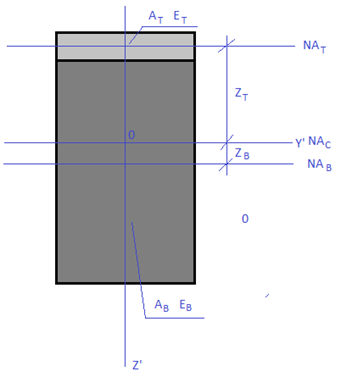
To determine the neutral axis position (NAC) of a composite bi-material cross-section, the following general equation is used:

where:
- EB and ET - elastic modulus of the bottom and top layer, respectively;
- AB and AT - cross-sectional area of the bottom and top layer, respectively;
- ZB and ZT - distance from the neutral axis to the centroid of the bottom and top layer, respectively.
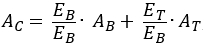
The reduced area AC of the composite bi-material cross-section is calculated as:
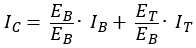
The reduced second moment of inertia IC of the composite cross-section is calculated as:
The material properties of the composite bi-material cross-section are reduced as follows:
|  |
|  |
|  |
The reduction of the cross-sectional area and the second moment of area is performed relative to the bottom layer of the composite cross-section
The elastic modulus of the reduced composite bi-material cross-section is taken from the bottom layer of the composite cross-section
The second moment of area for the top and bottom layers is calculated with reference to the neutral axis of the composite cross-section, without taking into account its bi-material nature
For standard prefabricated composite sections, the bottom part of the cross-section is considered prefabricated, while the top part serves primarily as a finishing or cover layer:
