
A Load combinations generator is an automated tool used to generate all necessary design combinations according to specific design standards. The generator processes user-defined load cases based on the selected standard (such as EN 1990 and EN 1991) and automatically compiles the required combinations according to the given boundary conditions and safety factors.
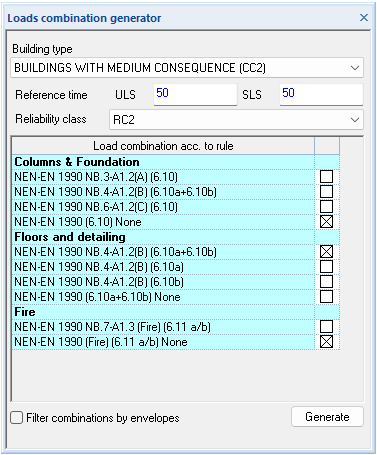
| Parameter | Description |
| Building type | Defines the building category according to EN 1990/EN 1991. This selection determines the load combination factors Ψ and load factors. |
| Reference time (ULS, SLS) | The design working life period. Automatically suggested based on the Building type, but can be adjusted manually. |
| Reliability class | Specifies the reliability level. Automatically suggested based on the Building type; manual override is available. |
| Load combination acc. to rule | Selects the relevant code article to compile the combination set. Determined automatically, but remains editable. |
The following grid outlines the configuration parameters used by the Load combinations generator to define load cases and combinations according to the EN 1990/EN 1991 standards:

| Parameter | Description |
| Label | The identifier for the combination (e.g., L.C.1, L.C.2, ... L.C.i). |
| Description | The descriptive name of the load case. |
| L.C. Type | Defines the load nature (e.g., Dead load, Imposed load, Snow, Wind, etc.). |
| Fav. / Unfav. | Specifies if the permanent load effect is favorable (+) or unfavorable (-). |
| Category | Defines the loading category according to EN 1990 / EN 1991. |
| Level | Indicates the structural level (floor/story) where the load is acting. |
| Field | Indicates the specific floor area or field where the load is applied. |
| Connected fields | Displays the Generative connected fields descriptor ID. This ID identifies loaded fields connected by common edges, typically generated in 2D-Grillage or FEM projects. |
| Ψi | Factor used to define the quasi-permanent load component. |
| Ψk | Correction factor applied to the quasi-permanent load. |
| Cprob (ULS, SLS) | Probability factor. In standard cases, Cprob = 1.0, corresponding to a 50-year reference period. |