
Definition of the P-load direction
The normal vector of a plane (N) is described as follows:
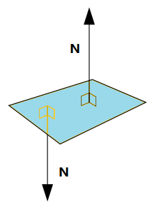
1. The rule for the plane's local Z’ axis direction:
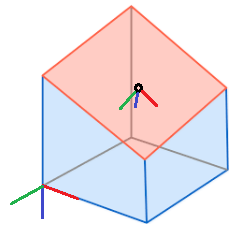
Common case:
The local Z’ axis of the plane is parallel to the normal vector of the plane. The Z’ axis is directed toward the lower half of the space divided by the plane (in the global direction of the Z axis).
Exceptions:
- If the normal vector of the plane is perpendicular to the global Z-axis, the local Z’-axis of the plane is parallel to the normal vector and is directed toward the far half-space divided by the plane (in the negative global Y-direction);
- If the normal vector of the plane is parallel to the global X-axis, the local Z’-axis is directed toward the right half-space divided by the plane (in the positive global X-direction).
2. The rule for the plane's local X’-axis direction:
- If the normal vector of the plane is parallel to the global X-axis, the local X’-axis of the plane is directed toward the near half-space divided by the plane (in the positive global Y-direction);
- Otherwise, the direction of the plane's local X’-axis always matches the projection of the global X-axis onto the plane.
3. The rule for the plane's local Y’-axis direction:
The direction of the local Y’-axis is determined by the cross product of the local Z’- and X’-directions of the plane.
Explanation:
| Case 1. Common case | Case 2. Exceptional case — the normal vector of the plane is perpendicular to the global Z-axis | Case 3. Exceptional case — the normal vector of the plane is parallel to the global X-axis |
| 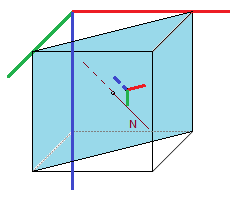 N ⊥ Z -> Z’ ∥ N | 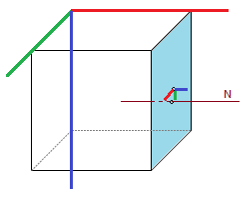 N ∥ X -> Z’ ∥ N and Z’ ∥ X |