
IC-Prefab and IC-Elms use Product Groups.
A product group refers to a collection of files that together ensure a specific type of product can be modeled according to the correct specifications.
In principle, the same product group can be used for both AutoCAD and Revit.
For practical reasons, separate versions may be created for AutoCAD and Revit.
A model can contain multiple product groups.
Naming of Product Groups
The term "product group" is often abbreviated as PG.
We distinguish several main groups, each indicated by a letter:
- C = Reinforcement cages
- H = Hollow walls
- I = Insulation
- K = Hollow core slabs
- M = Solid walls
- R = Rib (cassette) floors
- S = Prestressed formplates
- V = Wide slab floors
For some products, a combination of two main groups may be required. For example, a combination of H and C for hollow walls and (prefab) reinforcement cages.
Main groups are further subdivided by manufacturer, represented by three digits. Each manufacturer typically has ten slots per main group. The combination 999 is reserved for demo product groups in IC-Prefab.
For certain product types, combining product groups is necessary. For example, I and K for insulated hollow core slabs.
What Does a Product Group contain?
A product group usually includes the following folders and files. The contents may vary depending on the product or manufacturer:
- DWGS: Contains AutoCAD blocks used for this product group, such as label bubbles (plate numbers) or embedded material representations.
- RFA: Contains Revit families used for this product group, including representations of plate numbers or embedded materials.
- Menufiles: Contains toolbar files required for this product group.
- Proto: Contains prototype drawings (.dwg) used as the basis for layout plans. These are also referred to as starter drawings or templates.
- SUB: Contains so-called SUB files, as well as dpa and spa files. All three types relate to properties of embedded materials.
How to Load a Product Group in a Model?
In AutoCAD, a product group can be loaded using the command READVARS or by clicking the "Load PG" button in the toolbar.
Then specify the name of the product group you want to load. Choose one of the following options:
- 0 = New project. All previously loaded product groups are removed, and the selected product group is loaded.
- 1 = The selected product group is added to the existing product groups in the model.
- 2 = If a product group is already present in the model, it is removed and then reloaded. Use this option when a product group has been updated.
If no product group is present when starting a new model, IC-Prefab will prompt you to select one to load.
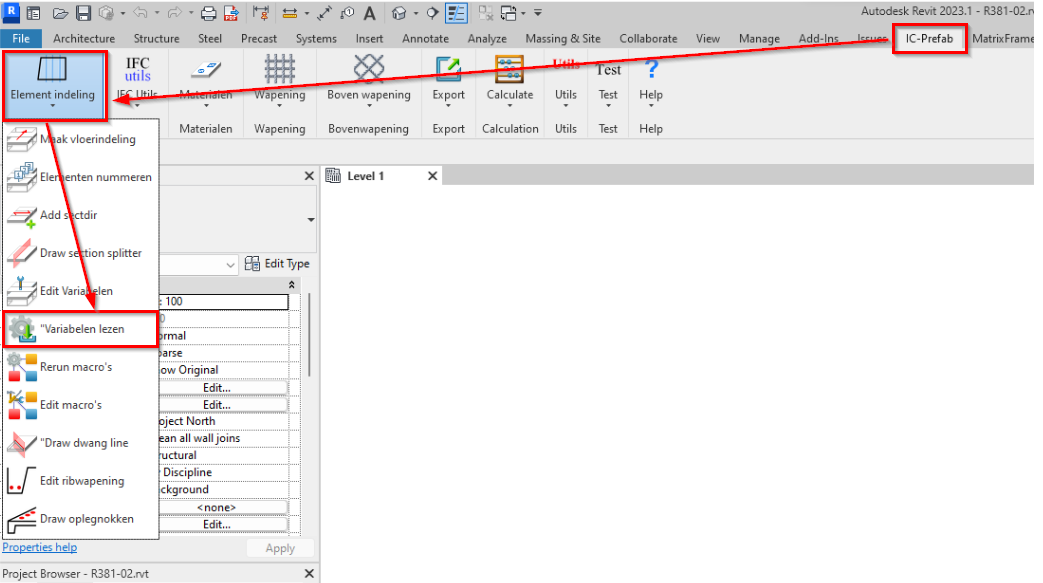
In Revit, you can load a product group by navigating to IC-Prefab → Element Layout → Read Variables.
In Revit, product groups are also referred to as variable sets.
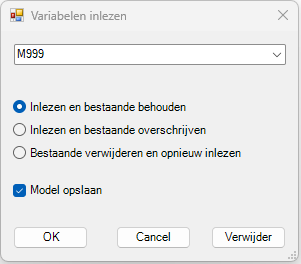
Than choose the desired Product Group from the dropdown menu and select the method for loading the Product Group
Can Product Groups be combined in one Model?
Yes, they can. Multiple product groups can be used within a single model.
For example, prestressed and traditionally reinforced wide slab floors, or rib cassette floors combined with insulated hollow core slabs.
For certain products, combining product groups is even necessary.
In such cases, we distinguish between the main product group (or leading group) and a supporting product group.
For instance, a main product group 'R' for ribbed floors, with a supporting product group 'I' for insulation.
Supporting product groups are automatically loaded when such combinations are required.
Embedded Materials in models with multiple Product Groups
When placing embedded materials in a model that includes multiple product groups,
you will be prompted to select which product group the embedded material should be taken from.
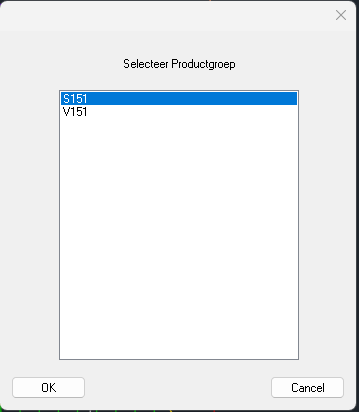
By doing so, the embedded material inherits the properties associated with the corresponding element.
Workshop drawings with multiple Product Groups in one model
When the model is filtered for the platenboek, it doesn't matter that multiple product groups are present.
Elements are displayed in order based on their element number in the platenboek.
For each element, the system checks which product group it belongs to.
However, the product group of the first element takes precedence in certain aspects—such as the layout of the cover page